dmesg --follow
[ 66153780.000 ] posts.x: @Mappletons The redesign isn’t live yet, BTW …  |   [ 66159420.000 ] posts.x: Full talk on why there's no single right chunk size and how multiscale indexing with RRF closes the gap:  |   [ 66159420.000 ] posts.x: A fixed chunk size is a bet on queries you haven't seen yet. @yuvalinthedeep, Sr. Developer Advocate at AI21, tests that bet in "Stop Chunking Like…  |   [ 66166140.000 ] posts.x: @hypeapps @toggl Is this because you’re straddling multiple agent sessions for multiple projects simultaneously?  |   [ 66166560.000 ] posts.x: @hypeapps @toggl You could still get pretty close. Agent sessions are stored on disk. Subtract the long gaps between your inputs to the session…  |   [ 66168660.000 ] posts.x: Full talk on why llms.txt isn't enough and what actually makes a website agent-ready:  |   [ 66168660.000 ] posts.x: Almost half of the websites in one study already publish an llms.txt file for agents to read, but almost none of the agents actually use it…  |   [ 66169620.000 ] posts.x: Full talk on why AI cluster networks need a receiver-driven, message-based protocol instead of TCP:  |   [ 66169620.000 ] posts.x: Most AI clusters still tune their networks for giant weight transfers, but the workloads pushing performance limits now are tiny messages: a KV cache…  |   [ 66179400.000 ] posts.x: Full talk on the harness layers, the files-vs-databases tradeoff, and context rot:  |   [ 66179400.000 ] posts.x: Most of what makes an AI agent reliable has nothing to do with the model itself. In "Total Recall: Agent Memory and Harness Engineering,"…  |   [ 66229440.000 ] posts.x: Astounding!  |   [ 66229560.000 ] posts.x: @lukebfox1 This was such a great game! We used to have all-night LAN parties on this one!  |   [ 66230100.000 ] posts.x: Curious what The Godfather thinks of this. @HamelHusain  |  
corey@gallon.me:~/conferences$

The Real Problem Is the Six Minutes After the Call
FIGURE 1 ⋅ The Real Problem Is the Six Minutes After the Call

Dippu Kumar Singh (LinkedIn), Leader of Emerging Technologies at Fujitsu North America, presents a talk that starts where most AI discussions stop. Most generative AI demos assume clean text input. In a contact center, the data starts as messy, overlapping, emotionally charged audio -- and the engineering challenge isn't transcription. It's what happens after the call ends.

"We cannot hire more people, we have to fundamentally engineer the stress out of the workflow."

The After-Call Work Problem

Singh's central reframe is about where the ROI actually lives. He shares internal baseline data showing the average contact center call lasts about 6.5 minutes -- and the post-call administrative work takes another 6.3 minutes. Operators spend nearly half their working hours on data entry, not talking to customers.

That near 1:1 ratio between talk time and paperwork creates a stress-turnover spiral. Operators burn out. Attrition rises. And as Singh argues, hiring more people doesn't fix a structural problem.
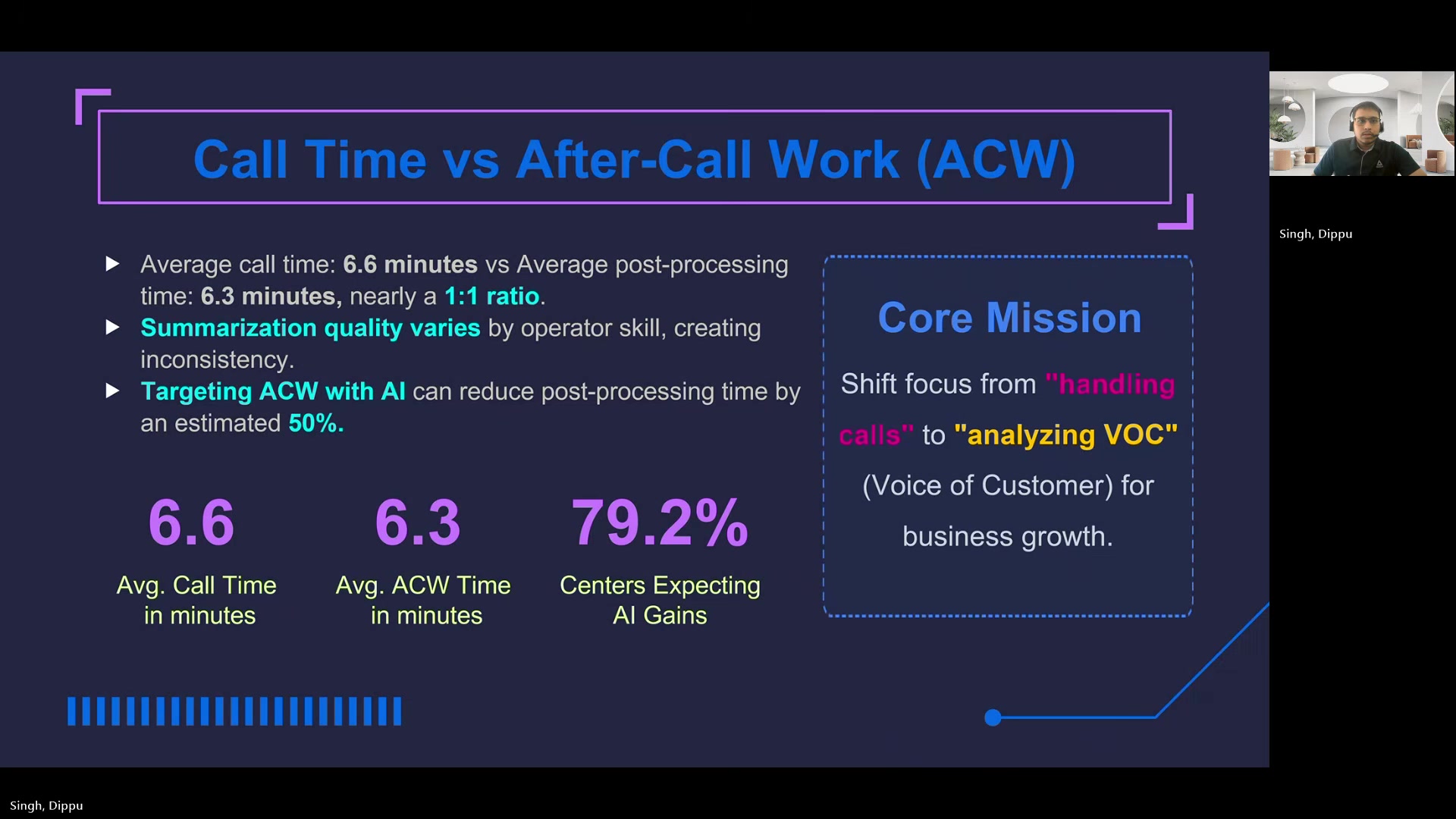
Slide showing call time vs. after-call work: 6.6 minutes average call time, 6.3 minutes average ACW time, with 79.2% of centers expecting AI gains. The core mission stated as shifting focus from handling calls to analyzing Voice of Customer.
FIGURE 2 ⋅ Slide showing call time vs. after-call work: 6.6 minutes average call time, 6.3 minutes average ACW time, with 79.2% of centers expecting AI gains. The core mission stated as shifting focus from handling calls to analyzing Voice of Customer.

The pipeline he describes isn't designed to replace the operator. It's designed to auto-populate structured output that the operator validates with a quick visual check and a confirm click -- turning a 6.3-minute writing task into a seconds-long review task.

Four Stages of the Pipeline

The system Dippu describes is a four-stage architecture deployed in a high-volume contact center.
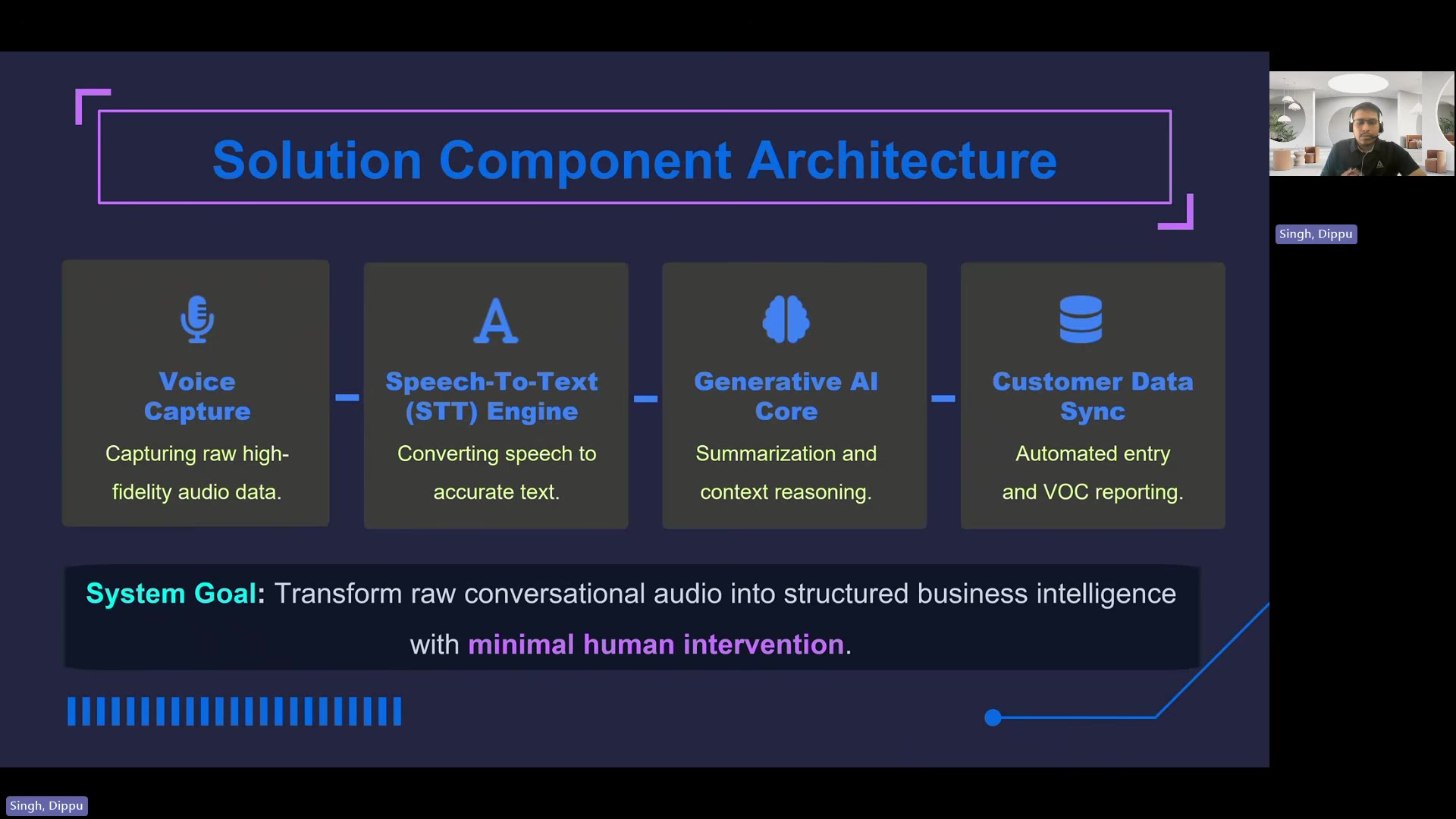
Solution component architecture showing four stages: Voice Capture (raw high-fidelity audio), Speech-to-Text Engine (converting speech to accurate text), Generative AI Core (summarization and context reasoning), and Customer Data Sync (automated entry and VOC reporting). System goal: transform raw conversational audio into structured business intelligence with minimal human intervention.
FIGURE 3 ⋅ Solution component architecture showing four stages: Voice Capture (raw high-fidelity audio), Speech-to-Text Engine (converting speech to accurate text), Generative AI Core (summarization and context reasoning), and Customer Data Sync (automated entry and VOC reporting). System goal: transform raw conversational audio into structured business intelligence with minimal human intervention.

Voice Capture handles real-time audio intake with noise filtering and level normalization. The critical detail here is stereo channel separation -- isolating the agent on one channel and the customer on the other.

"If you mix them into a single mono track, overlapping with each other, the AI will struggle to figure out who said what and thereby ruining the entire downstream summary."

PII masking happens at this stage too. Credit card numbers and passwords are stripped from the audio buffer before anything reaches the LLM.

Speech-to-Text converts the cleaned audio. Singh says the STT accuracy needs to exceed 90% for the downstream AI to function. Domain-specific dictionaries help -- distinguishing "term life" from "turn right" in an insurance context, for example. Post-processing handles inverse text normalization, so spoken "five thousand dollars" becomes "$5,000" before entity extraction.

Generative AI Core is structured in three layers. An orchestration layer uses few-shot prompt libraries rather than open-ended "summarize this call" instructions. A reasoning layer classifies the call against a predefined list of categories (cancellation, new application, claim status) and outputs its reasoning. A trust layer handles token optimization for latency and automated hallucination checks.
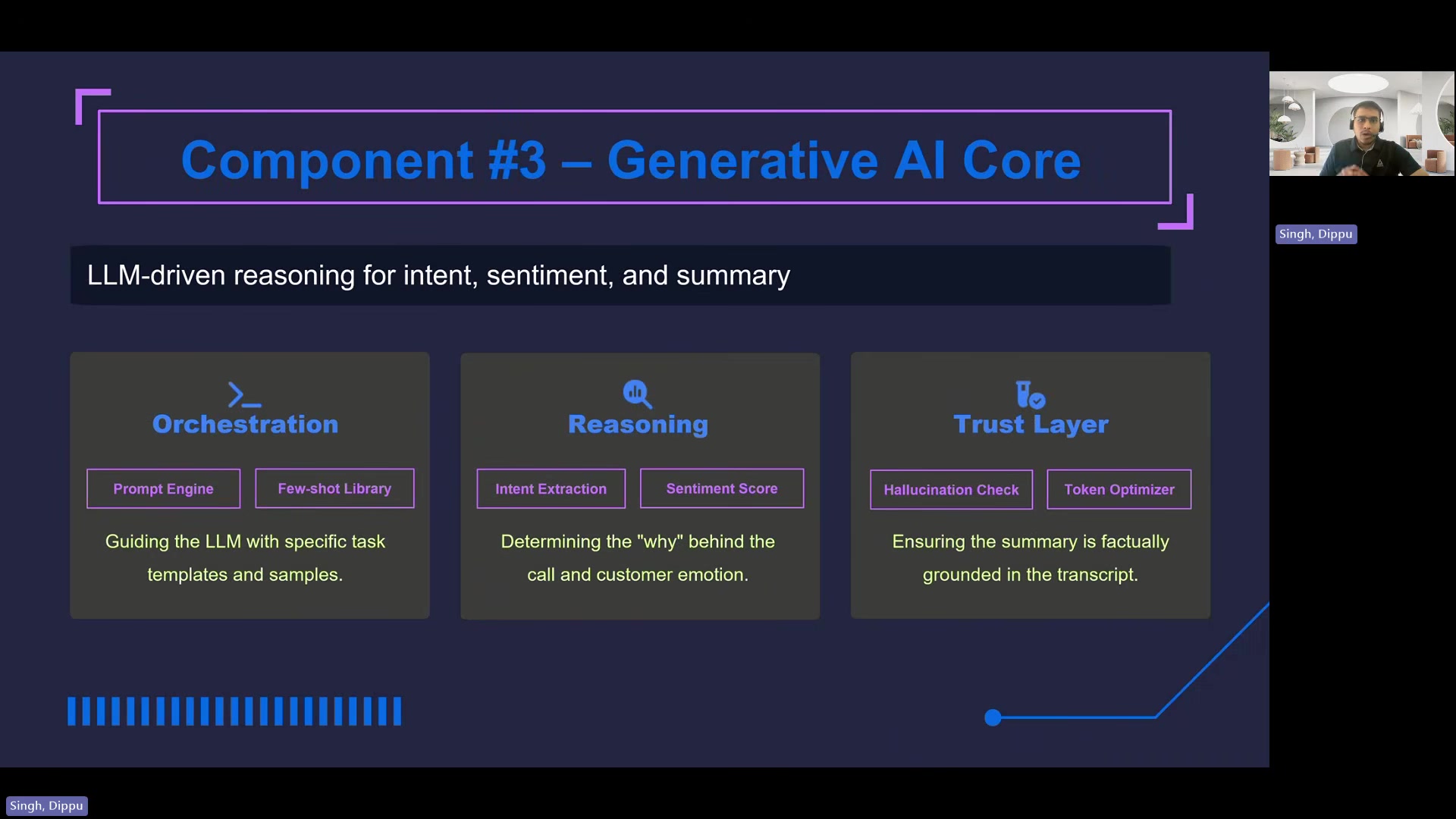
The Generative AI Core broken into three layers: Orchestration (guiding the LLM with specific task templates and samples via prompt engine and few-shot library), Reasoning (determining the why behind the call and customer emotion via intent extraction and sentiment score), and Trust Layer (ensuring the summary is factually grounded in the transcript via hallucination check and token optimizer).
FIGURE 4 ⋅ The Generative AI Core broken into three layers: Orchestration (guiding the LLM with specific task templates and samples via prompt engine and few-shot library), Reasoning (determining the why behind the call and customer emotion via intent extraction and sentiment score), and Trust Layer (ensuring the summary is factually grounded in the transcript via hallucination check and token optimizer).

Customer Data Sync maps the LLM's JSON output to CRM fields via an API gateway. The operator sees the AI-generated summary auto-populated on screen, makes any corrections, and confirms.

Why "Just Summarize" Doesn't Work

One of the more concrete points Dippu makes is about prompt design. He argues that asking an LLM to summarize a call produces a messy narrative paragraph -- not something you can feed into a CRM.

The alternative: structured few-shot prompts that instruct the LLM to output separate bullet-point lists -- one for customer inquiry, one for operator actions. The model receives a predefined list of call reasons and must classify against them while showing its work.

"This strict formatting is what turns an unstructured conversation into a database-ready asset."
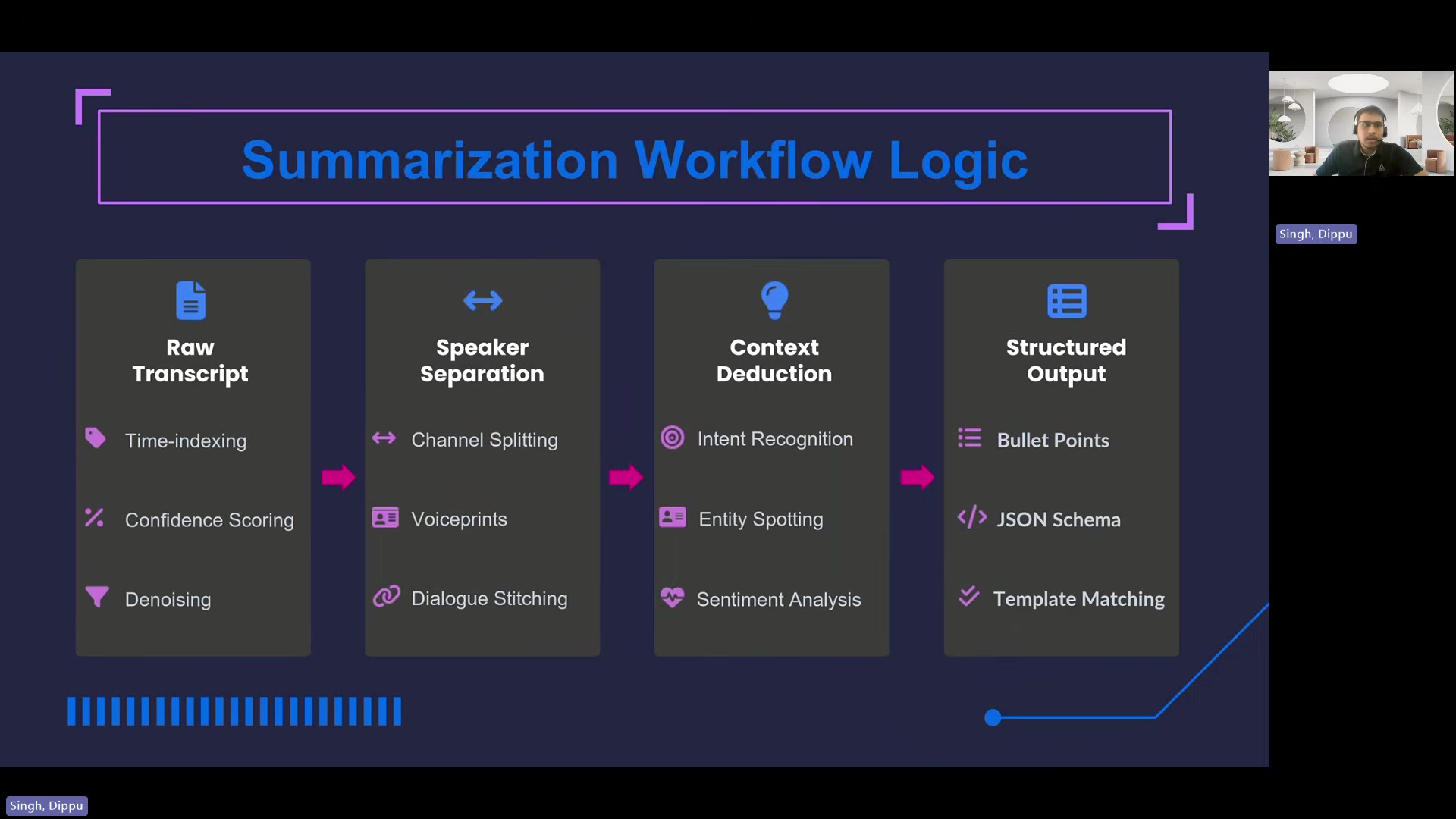
Summarization workflow logic showing four stages: Raw Transcript (time-indexing, confidence scoring, denoising), Speaker Separation (channel splitting, voiceprints, dialogue stitching), Context Deduction (intent recognition, entity spotting, sentiment analysis), and Structured Output (bullet points, JSON schema, template matching).
FIGURE 5 ⋅ Summarization workflow logic showing four stages: Raw Transcript (time-indexing, confidence scoring, denoising), Speaker Separation (channel splitting, voiceprints, dialogue stitching), Context Deduction (intent recognition, entity spotting, sentiment analysis), and Structured Output (bullet points, JSON schema, template matching).

This is where the audio quality decisions upstream pay off. Speaker separation means the LLM can distinguish customer intent from operator chit-chat. Without it, the structured extraction falls apart.

The Results

Singh reports that after-call work dropped to 3.1 minutes -- roughly a 50% reduction. Across what he describes as a 500-seat operation handling thousands of calls per day, that translates to what he characterizes as the equivalent of reclaiming dozens of full-time headcounts in productivity.
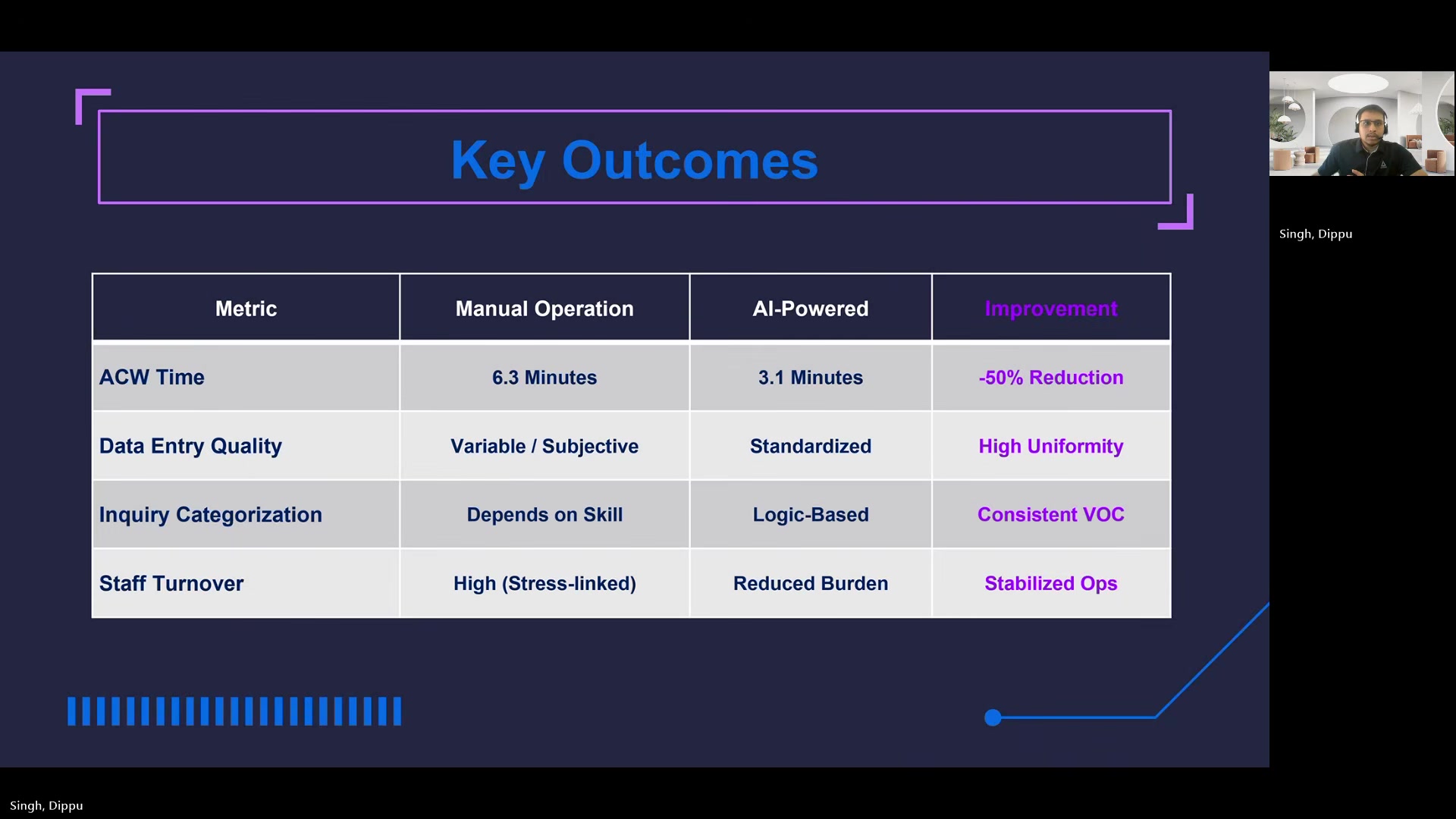
Key outcomes table comparing manual operation to AI-powered results: ACW time dropped from 6.3 to 3.1 minutes (50% reduction), data entry quality moved from variable/subjective to standardized (high uniformity), inquiry categorization shifted from skill-dependent to logic-based (consistent VOC), and staff turnover went from high stress-linked to reduced burden (stabilized ops).
FIGURE 6 ⋅ Key outcomes table comparing manual operation to AI-powered results: ACW time dropped from 6.3 to 3.1 minutes (50% reduction), data entry quality moved from variable/subjective to standardized (high uniformity), inquiry categorization shifted from skill-dependent to logic-based (consistent VOC), and staff turnover went from high stress-linked to reduced burden (stabilized ops).

Structured data from the pipeline also flows into BI dashboards that aggregate voice-of-customer patterns and auto-flag candidates for new FAQ entries -- a secondary benefit that turns call data into a strategic asset.

What Comes Next

Dippu closes with the argument that this kind of pipeline transforms contact centers from high-stress call centers into what he calls "intelligence-gathering engines."

"By applying these rigorous engineering techniques to the messy audio data, we can definitely transform the contact centers from call centers of high stress into highly efficient intelligence-gathering engines that protect their workforces."


Dippu Kumar Singh spoke at AI Engineer Europe 2026. Leader of Emerging Technologies (Apps) at Fujitsu North America.

Watch the full talk | Slides | LinkedIn

corey@gallon.me:~$ tail -f /writing Attach to the stream. An email when I have something worth sending. Replies encouraged!
corey@gallon.me:~$ ls -lt /conferences ↑2026-04-12 Fitting the Model Isn't the Same as Running It Well
▸2026-04-12 The Real Problem Is the Six Minutes After the Call ⋅ you are here
↓2026-04-12 AI-Generated Code Is Just Untrusted Code From the Internet