Your Digital Exhaust Is the Most Underused Dataset You Own
Šimon Podhajský (LinkedIn, X), Head of AI at Waypoint AI, opened with a premise that cuts against the grain of most personal AI demos: what if the most valuable thing an AI can do with your data is simply read it?
Every other personal AI project seems to be racing toward agents that send emails and manage calendars on your behalf. Podhajský built the opposite -- a read-only system that queries six personal data sources (email, journal, tasks, CRM, browser sessions, notes) but can never write back to any of them. He argues this isn't a limitation to overcome. It's the point.
"It's my term for the digital activity that is a byproduct of your cognition, like exhaust fumes for a car engine. Individually, it's just waste, but if you analyze the exhaust, you can diagnose the engine."
Cross-Source Signal Is the Product
The core of Šimon's argument is that individual tools are blind to each other. Your email client doesn't know what you journaled. Your task manager doesn't know what you're browsing. The value isn't in any single data source -- it's in the patterns that emerge when you read across all of them.
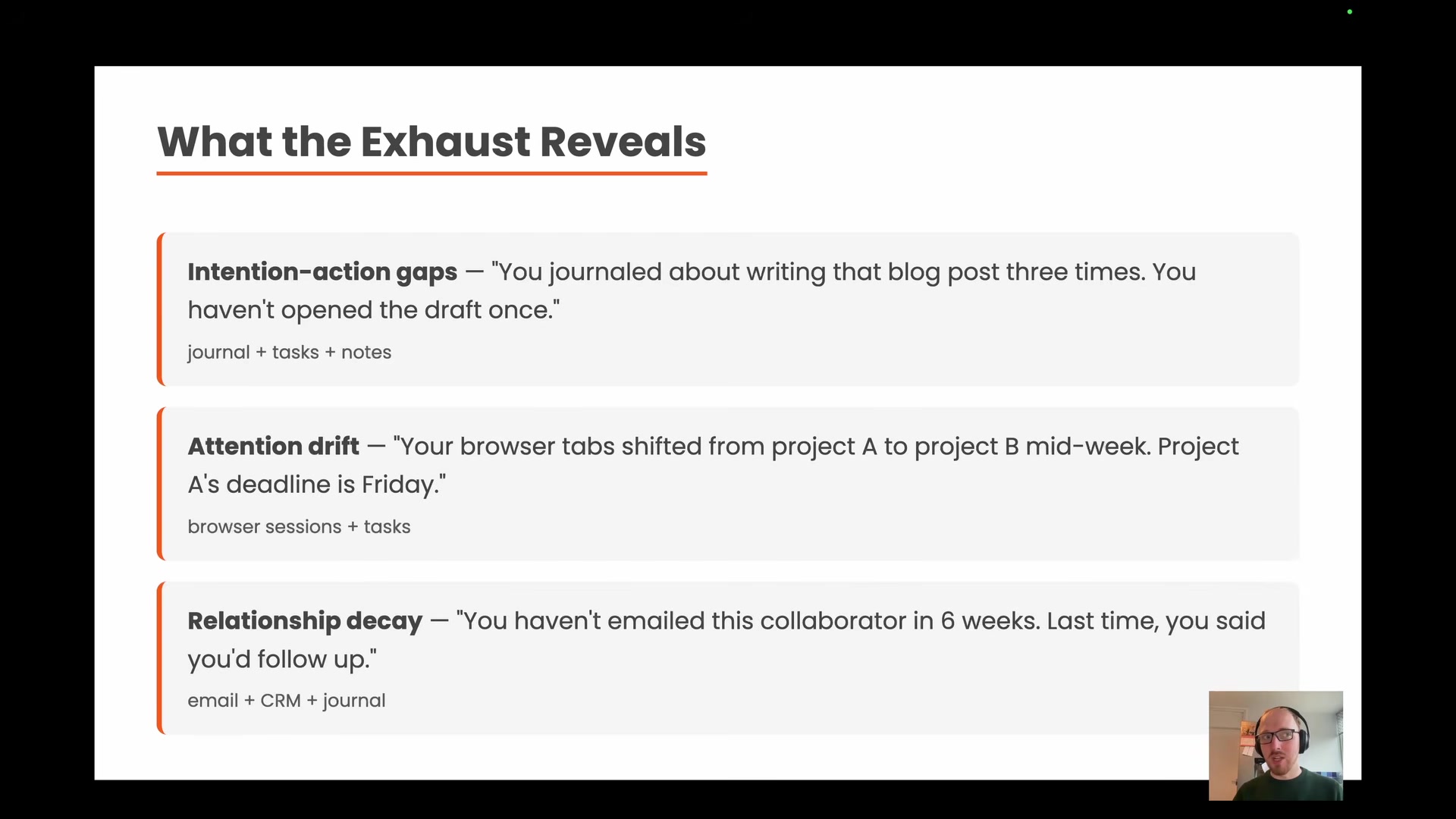
He demonstrated three use cases, all requiring cross-source analysis:
- Intention-action gaps: Comparing what you said you'd do (tasks, journal entries) against what you actually did (email, browser activity).
- Attention drift: Detecting when your browsing patterns diverge from your stated priorities.
- Relationship decay: Surfacing contacts you've been neglecting by cross-referencing CRM data against communication patterns.
Three Zones, No Write Path
The architecture is deliberately simple. Šimon described three zones:
- Sources -- the six data sources, all read-only. The AI never writes back.
- Workspace -- where analysis happens, using structured prompts and Python scripts.
- Outputs -- results land in a separate destination (he uses an Obsidian vault), never back into the source systems.
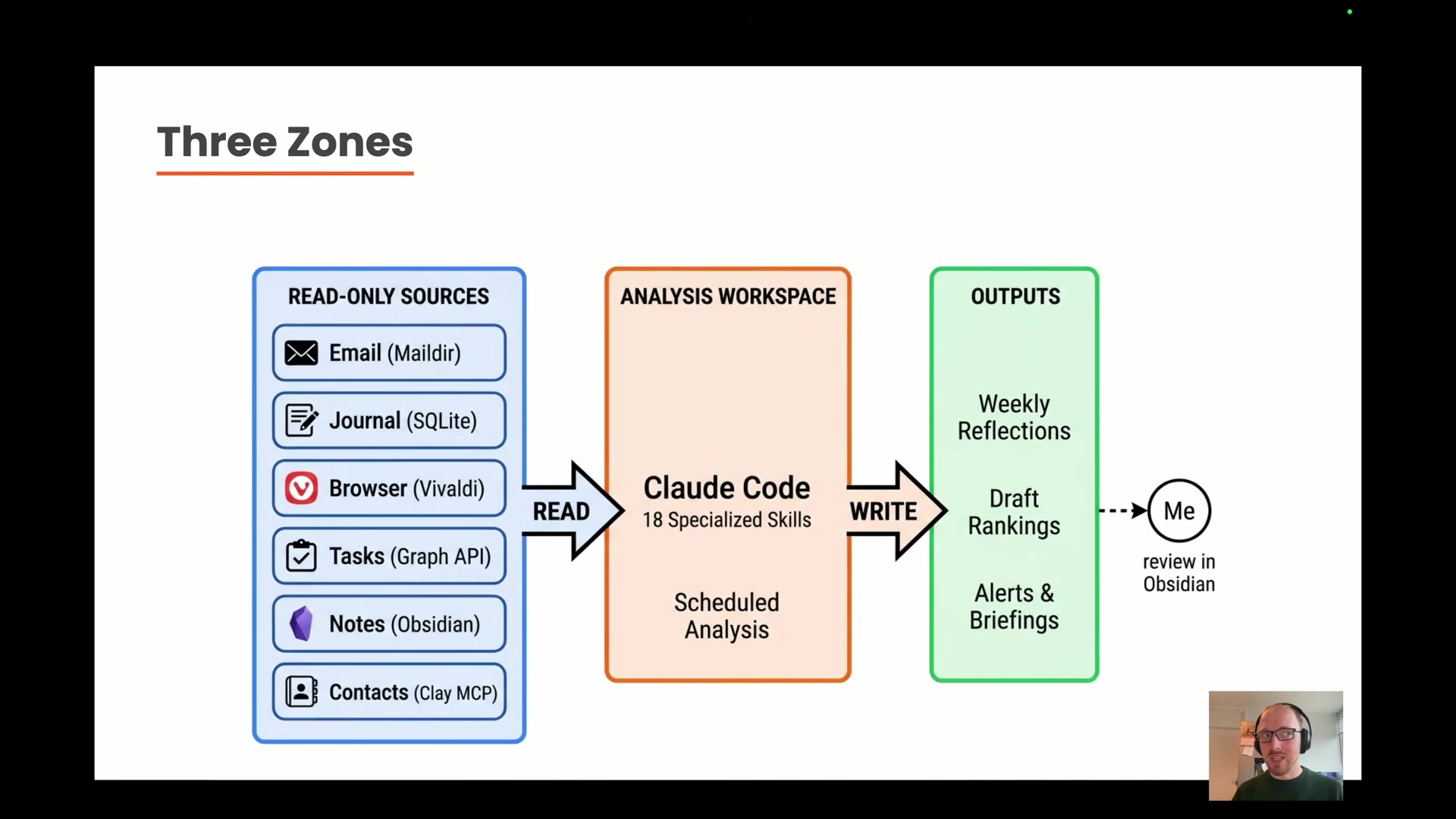
The separation between sources and outputs is load-bearing. Podhajský argues that the moment an AI writes back to your data sources, the exhaust is contaminated -- you can no longer tell which patterns are yours and which are the AI's.
"The moment your AI writes to your data sources, the exhaust fumes are contaminated. You're no longer observing your cognition. You're observing a human-AI hybrid, and you can't tell which patterns are yours."
The Weekly Mirror
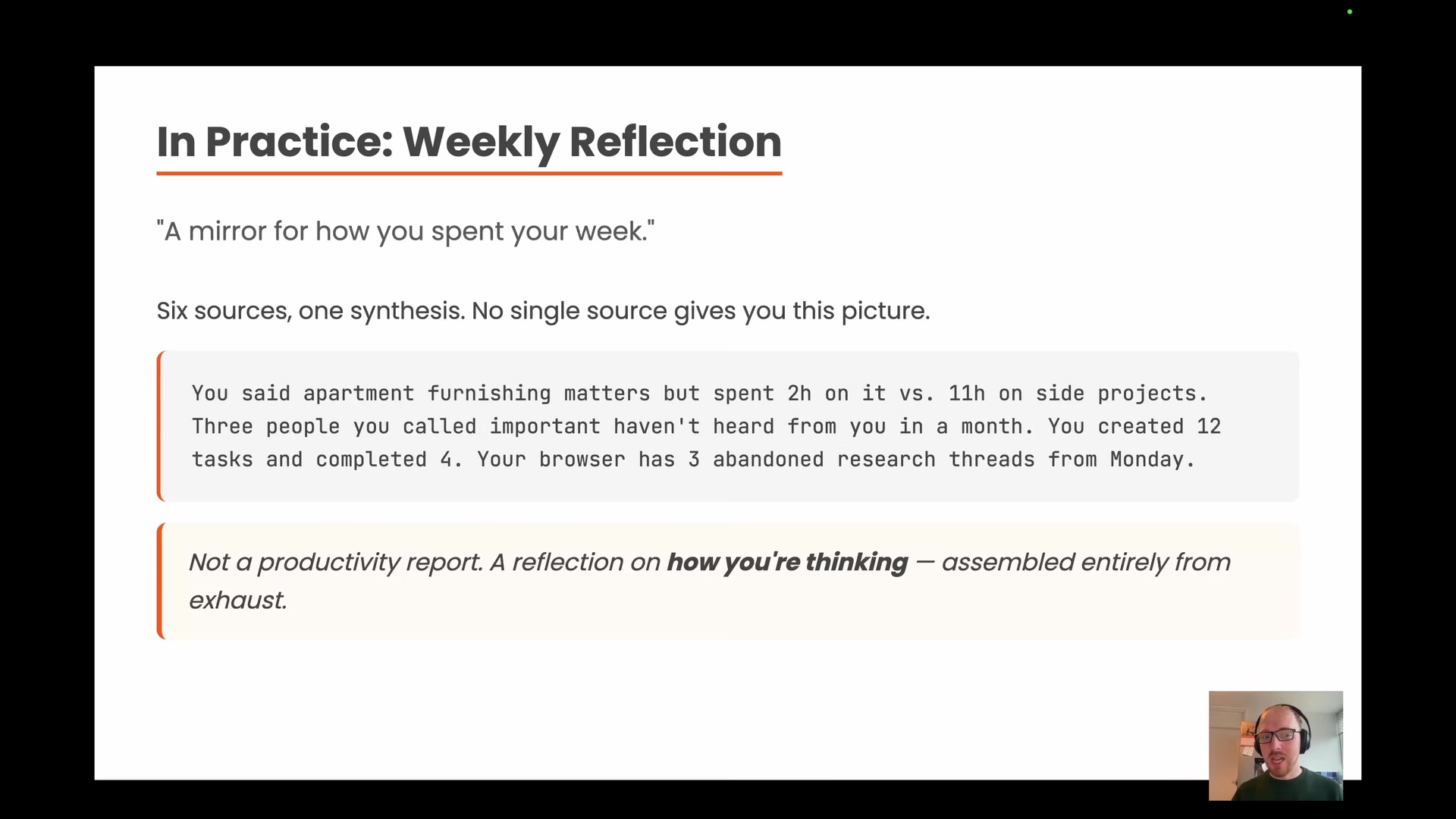
In a live demo, Šimon ran a weekly reflection -- a David Allen-style review generated by pulling data from all six sources and synthesizing it into a markdown document. The output covers themes of the week, tensions, commitments, relationship gaps (notable for what's missing, not just what's present), and reflection questions.
He described the output as "occasionally brutal." The system told him he'd been avoiding his most important project for two weeks -- something no single tool would have flagged.
A second demo showed cross-source reading recommendations: given what he's currently reading (pulled from his browser's local SQLite database), who in his network should he discuss it with? The system matched articles to contacts by interest. He noted the CRM integration was the slowest part and the whole thing is token-heavy -- best run in a clean session.
Read Errors Are Free, Write Errors Are Not
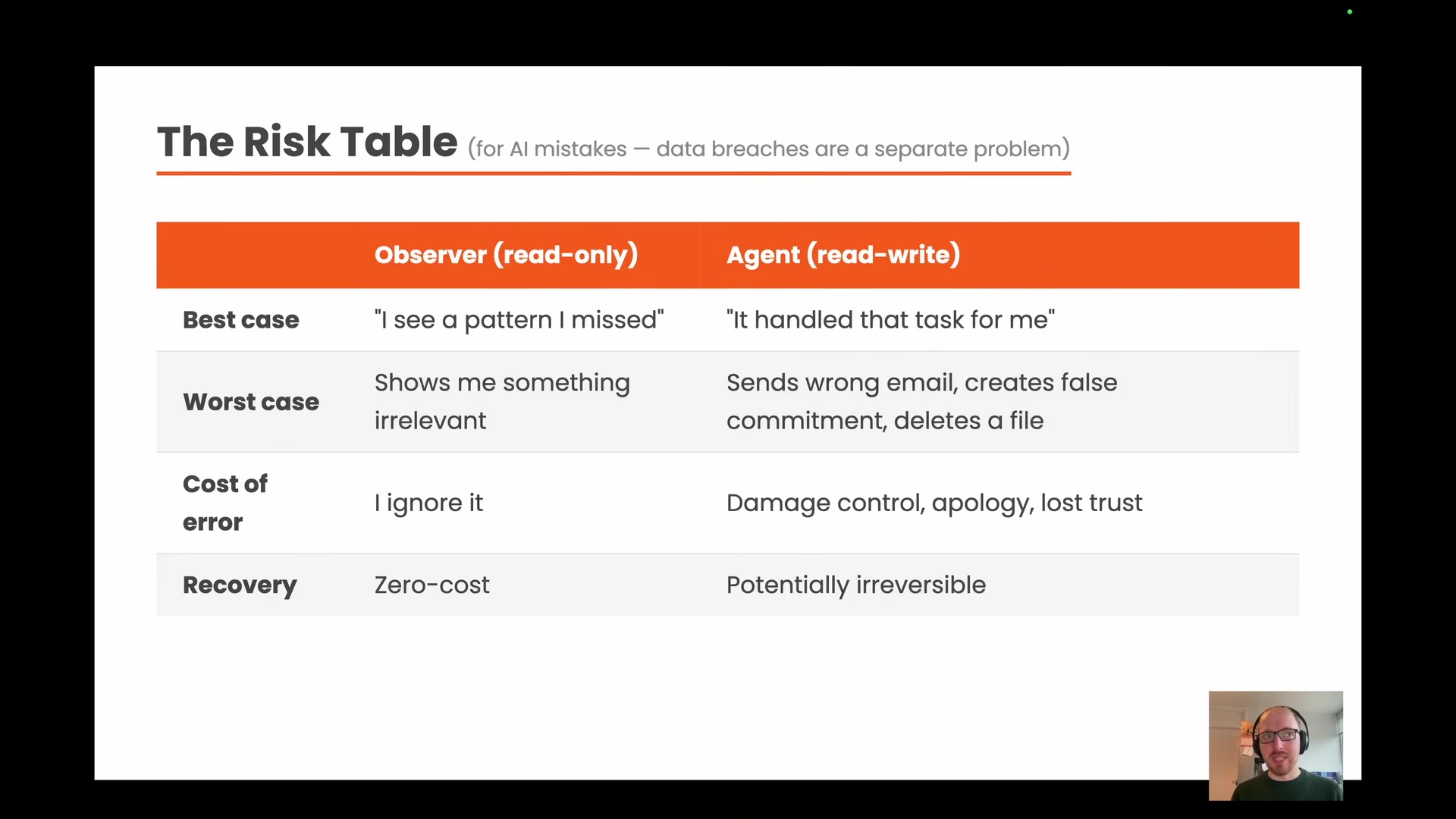
Podhajský's risk analysis is where the talk gets sharp. He frames the choice between read-only and agentic AI as fundamentally asymmetric:
"The downside of a read-only error is zero. I just ignore it. The downside of a write error is unbounded."
Or, more bluntly: "I'd rather miss out on automated emails than have a misfire nuke my life."
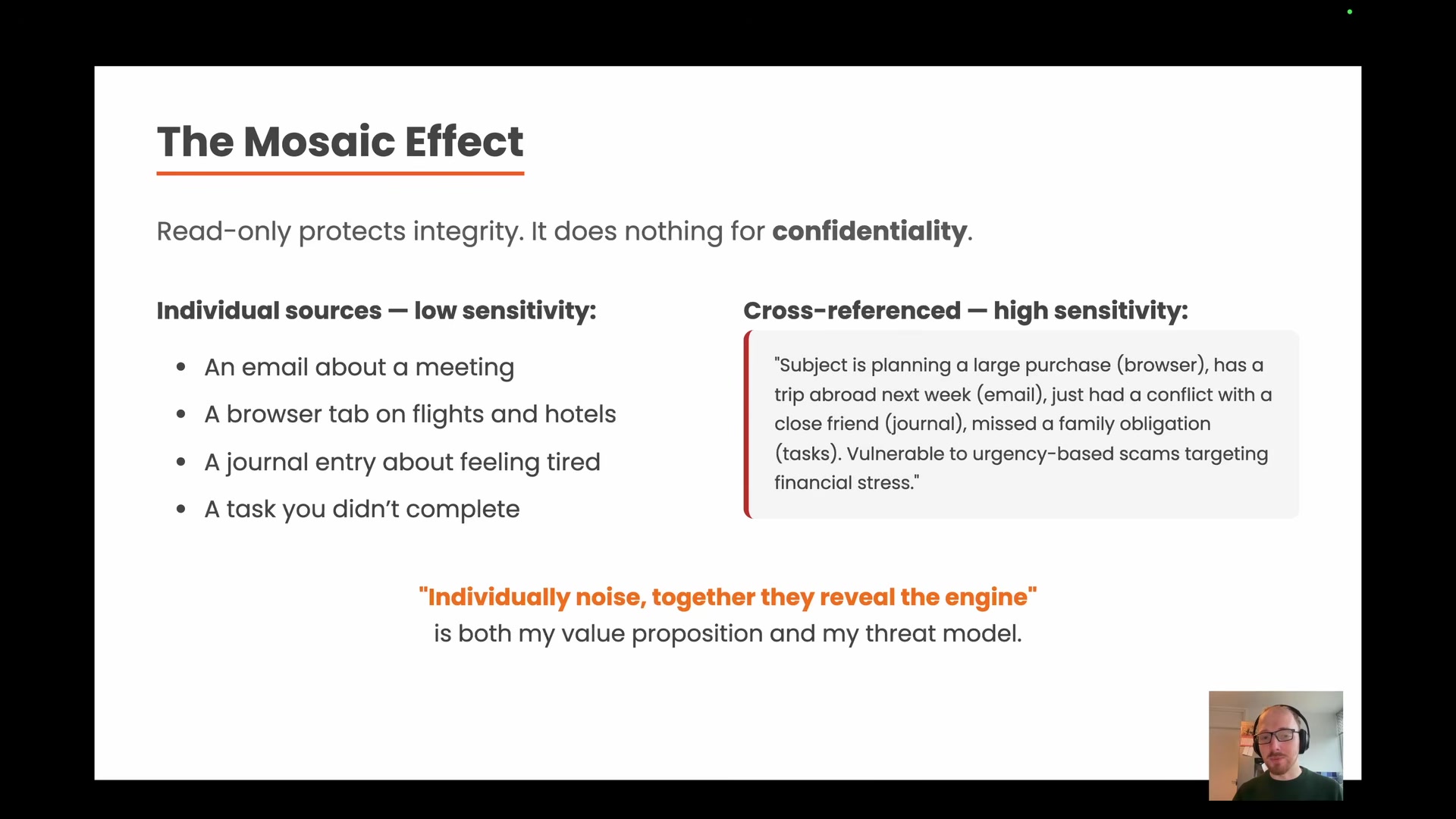
He also acknowledged the risks that remain. Cross-referencing personal data creates what he calls the mosaic effect -- the same capability that makes the system useful makes it a devastating target if compromised.
He referenced Simon Willison's "lethal trifecta" (private data, untrusted content, external communications) and initially thought his read-only design broke it, but conceded it doesn't fully -- shell access still provides external communication channels.
"I'm not claiming the system is secure. I'm claiming that I've thought about where it isn't and I've decided which risks I'm willing to carry."
A Mirror, Not a Broken Butler
The sharpest reframe in the talk is Šimon's insistence that read-only AI isn't a stepping stone toward "real" agentic AI. It's a different product category entirely.
"A mirror isn't a broken butler."
The industry, he argues, frames read-only as a limitation you graduate from. He thinks that's wrong. The observer -- the system that shows you what you're actually doing versus what you think you're doing -- produces more value per interaction than the agent, in his experience. The race to build personal AI agents that act on your behalf skips over something more fundamental: most people don't have a clear picture of their own cognitive patterns. He published an open-source template for others to try the approach.
"Your digital exhaust is the most underused dataset you own."
Šimon Podhajský spoke at AI Engineer Europe 2026. Head of AI at Waypoint AI.
Watch the full talk | Slides | Personal Intelligence Kit (GitHub) | LinkedIn | X