dmesg --follow
[ 66151680.000 ] posts.x: Full talk on training a search sub-agent with RL, and the speed and cost gains that come with it:  |   [ 66153540.000 ] posts.x: @hypeapps This kind of time tracking is quite important. Until you’ve logged how long projects (and, if you’re as easily distracted as I am…  |   [ 66153720.000 ] posts.x: @Mappletons I’ve been redesigning my personal site this past week and I’ve studied your site extensively as a great example. I really appreciate your…  |   [ 66153780.000 ] posts.x: @Mappletons The redesign isn’t live yet, BTW …  |   [ 66159420.000 ] posts.x: Full talk on why there's no single right chunk size and how multiscale indexing with RRF closes the gap:  |   [ 66159420.000 ] posts.x: A fixed chunk size is a bet on queries you haven't seen yet. @yuvalinthedeep, Sr. Developer Advocate at AI21, tests that bet in "Stop Chunking Like…  |   [ 66166140.000 ] posts.x: @hypeapps @toggl Is this because you’re straddling multiple agent sessions for multiple projects simultaneously?  |   [ 66166560.000 ] posts.x: @hypeapps @toggl You could still get pretty close. Agent sessions are stored on disk. Subtract the long gaps between your inputs to the session…  |   [ 66168660.000 ] posts.x: Full talk on why llms.txt isn't enough and what actually makes a website agent-ready:  |   [ 66168660.000 ] posts.x: Almost half of the websites in one study already publish an llms.txt file for agents to read, but almost none of the agents actually use it…  |   [ 66169620.000 ] posts.x: Full talk on why AI cluster networks need a receiver-driven, message-based protocol instead of TCP:  |   [ 66169620.000 ] posts.x: Most AI clusters still tune their networks for giant weight transfers, but the workloads pushing performance limits now are tiny messages: a KV cache…  |   [ 66179400.000 ] posts.x: Full talk on the harness layers, the files-vs-databases tradeoff, and context rot:  |   [ 66179400.000 ] posts.x: Most of what makes an AI agent reliable has nothing to do with the model itself. In "Total Recall: Agent Memory and Harness Engineering,"…  |  
corey@gallon.me:~/til$

Wrap with HTML tags in VSCode

FIGURE 1 ⋅ Wrap with HTML tags in VSCode

Using the Emmet capabilities in VSCode (see previous TIL) you can highlight a section of HTML code and quickly wrap it with other HTML using Emmet shortcuts.

This is particularly useful when writing plain HTML and then returning to style it.

You can access this functionality in the command palette

wrap in command palette
FIGURE 2 ⋅ wrap in command palette

Smarter, still, is to create a keyboard shortcut for this. We’ll bind ALT+M to this functionality.

create keyboard shortcut
FIGURE 3 ⋅ create keyboard shortcut

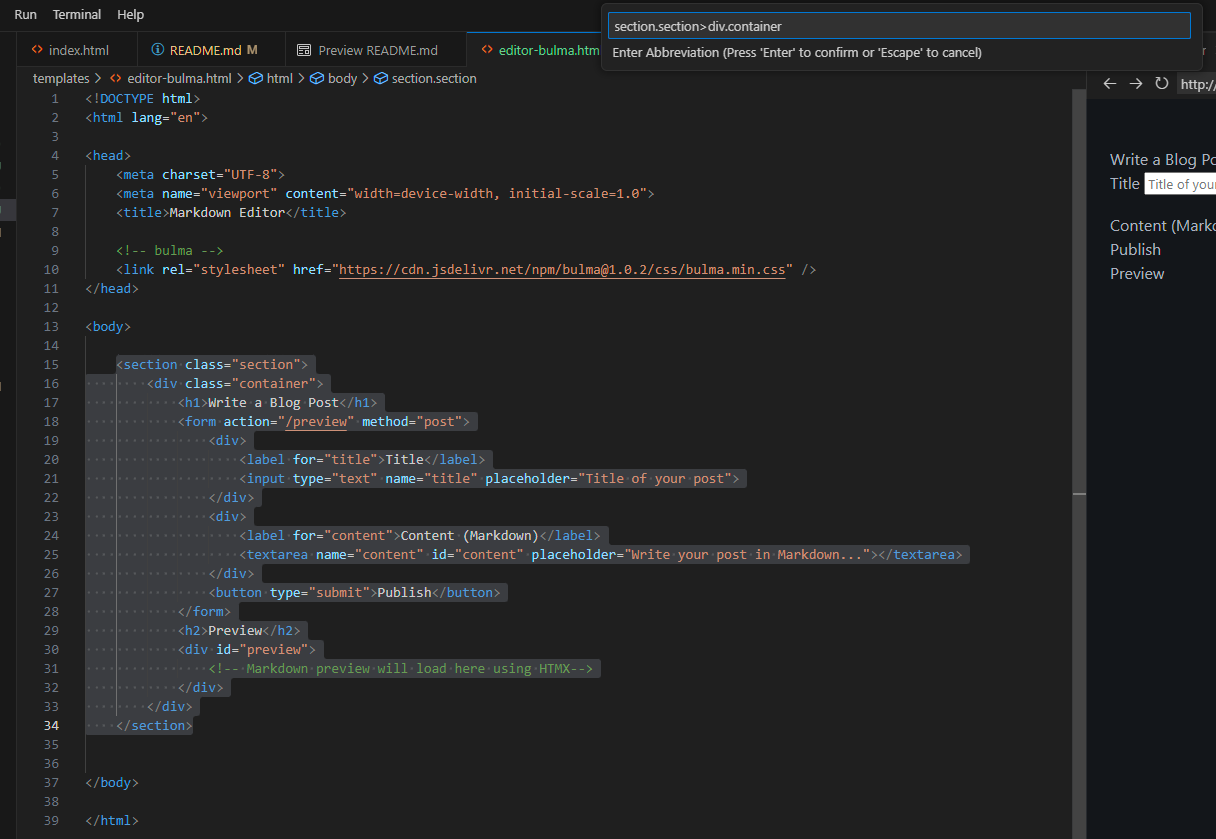
Now, simply highlight the HTML code you want to wrap, hit ALT+M and start typing the Emmet abbreviations for the tags you want to wrap the code with. For example, we’ll wrap this simple HTML form with some BulmaCSS classes to improve layout …

wrap with tags
FIGURE 4 ⋅ wrap with tags

et voila!

corey@gallon.me:~$ tail -f /writing Attach to the stream. An email when I have something worth sending. Replies encouraged!
corey@gallon.me:~$ ls -lt /til ↑2024-11-28 Why An 8TB Drive Isn’t 8 Usable TB
▸2024-11-14 Wrap with HTML tags in VSCode ⋅ you are here

↓2024-10-15 A nice workflow for creating Python projects with AI